Durable growth starts with the customers already on the books.
The Retention Flywheel
By Jason Kumpf, Strategy Advisor · September 14, 2026
Durable growth starts with the customers already on the books.
By Jason Kumpf, Strategy Advisor · September 14, 2026
Every growth plan starts with the same instinct: add more customers. That instinct undersells the math. The customers a company already has are the fastest path to compounding revenue, and net revenue retention puts a precise number on why.
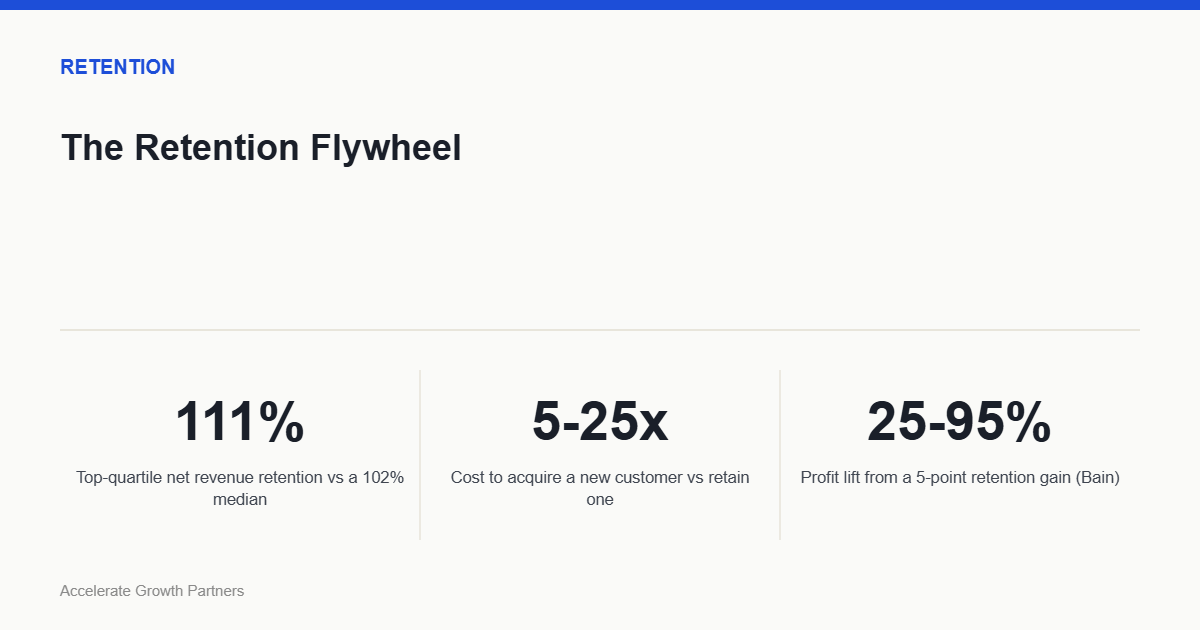
Net revenue retention measures how much revenue a cohort of existing customers produces a year later, combining expansion, downgrades and cancellations into a single figure. Anything above 100 percent means the existing customer base is growing on its own before a single new logo gets signed. SaaS Capital's 2025 Retention Benchmarks for private B2B software companies, published in September 2025, found that among companies with annual contracts between 25,000 and 50,000 dollars, median net revenue retention reached 102 percent while the top quartile reached 111 percent. Across the full study population, companies with net revenue retention above 110 percent grew faster than the median growth rate of 24 percent, while companies below 100 percent retention fell behind it.
A separate benchmark tells the same story from a different angle. Pavilion and Benchmarkit's 2025 SaaS Performance Metrics report, drawn from a broad base of B2B software companies, puts median net revenue retention at 101 percent, down from 105 percent in 2021. Retention has gotten harder to sustain across the board. That makes the gap between median and top-quartile performance more valuable, not less, because the companies still expanding their existing accounts are separating from a field that is mostly treading water.
The reason this gap compounds into a durable growth advantage comes down to unit economics. Harvard Business Review has reported that acquiring a new customer costs five to 25 times more than retaining an existing one. Frederick Reichheld's research at Bain & Company found that a five percentage point improvement in customer retention rate increases profit by 25 to 95 percent. Put those two findings together and the flywheel comes into view. A dollar spent deepening an existing relationship produces a larger return than the same dollar spent finding a new one, and that return shows up directly in profit rather than only in bookings.
This is why net revenue retention behaves less like a lagging indicator and more like a growth lever in its own right. A company growing 20 percent a year on 90 percent net revenue retention is working against a headwind, replacing lost revenue before it can add new revenue on top of it. A company growing 20 percent a year on 115 percent net revenue retention is compounding: the existing base contributes 15 points of growth by itself, and new business only has to cover the remaining five. That difference changes what a commercial budget needs to accomplish, and it changes how much new pipeline is required to hit the same growth number.
Building toward that kind of retention profile starts with where a commercial team puts its attention. Expansion revenue, upsells, cross-sells and usage growth within the existing base deserve the same forecasting discipline and the same executive attention as new-business pipeline. Renewal conversations should start well before a contract's end date, framed around outcomes the customer has already achieved rather than the terms of the next invoice. Sales, product and customer success teams benefit from a shared view of which accounts are expanding, which are flat and which show early signs of pulling back, because the best time to correct course is months before a renewal, not during the renewal call itself.
The accounts already on the books also carry information new-logo pipeline cannot provide on its own. They show which use cases stick, which features drive expansion and which customer profiles are worth pursuing more of. Treating retention data as a strategic input rather than a finance metric turns the existing customer base into a guide for where the next dollar of growth investment should go.
None of this argues for spending less on new customer acquisition. It argues for sequencing the investment correctly. A growth plan built on a strong retention foundation gets more out of every new customer added, because that customer joins a base that expands on its own rather than one that has to be continually refilled. Over several years, that difference produces two very different growth trajectories from the same starting revenue and the same market opportunity.
Net revenue retention rarely gets the same scrutiny that pipeline coverage and win rates receive in a typical growth review. It should. Among the metrics available to a growth team today, it is one of the clearest signals for whether growth is being built on a foundation or built on a treadmill.